Here's a direct link to the article, complete with some good photos:
http://www.riverlandnews.com/content/life-fast-lane
Just in case that doesn't work, I've copied the article below. Their editor did a great job of not skewing my words and presenting some great information. The article is sort of written about "me", but it's really mostly about the event and FAST.
Riverland News wrote: Life in the FAST lane
Dunnellon High grad finds thrills in autocross
By Jeff Bryan
Thursday, June 22, 2017 at 8:44 am
For one day, at least, the roar of the engines at the Dunnellon-Marion County Airport had nothing to do with aviation.
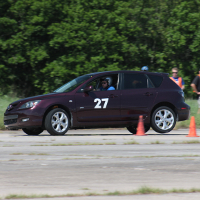
And that’s because the decades-old facility was converted into a raceway of sorts, as FAST (Fun Autocross Society of Tampa) was using the facility as an autocross course.
FAST is an autocross club based in the Tampa area that started in 2007, and has roots with another club dating back to about 1998, according to Loren Williams, the director of the organization.
“Our goal is to present frequent and well-organized autocross events to give drivers an opportunity to have some fun and improve their car control skills in a safe environment with extremely low risk,” said Williams, a 1984 graduate of Dunnellon High School. “We try to satisfy our ‘need for speed’ without getting in trouble on the street, and without the expense and time required to go to a big race track, such as Sebring.”
Autocross is a timed motorsports competition that emphasizes driver skill over speed, Williams explained.
“We set up our courses using orange traffic cones on open expanses of pavement, like big unobstructed parking lots or unused runways, and we run one car at a time for best time,” he said.
To keep the competition fair and interesting, cars are divided into several classes depending on the capability of the car and its level of modification.
“We’re mainly just out to have a good time,” said Williams, who wasn’t able to compete Saturday at the Dunnellon-Marion County Airport and spent most of the afternoon directing traffic, er, racers. “But it is human nature to want to be competitive.”
Williams got his first taste of autocross racing in 1995. Since then, he has done at least one race a month, but during the past few years, he’s competed at least twice a month.
“I should be pretty close to 300 autocrosses by now,” he exclaimed.
It wasn’t his Dunnellon connection, per se, that led FAST to securing the Dunnellon-Marion County Airport as a host site, but it just so happened to be fate, Williams explained, and the need for another open facility.
“First and foremost, suitable autocross sites are getting harder and harder to find,” he said. “Most large parking lots constructed within the past 30 years have been ‘beautified’ with curbing and islands of green space and light poles, which almost always makes them unusable for autocross. We need open space.
“And the abandoned runways are getting gobbled up by developers and turned into industrial parks, housing subdivisions or strip malls. So, we’ve looked everywhere within a couple hours of our ‘home base’ of Tampa to see what’s available. We pretty much know what’s out there.
“In Tampa, we’re down to just two usable locations, and one of those is in Brooksville,” he explained. “We know that ‘things happen’ and we could lose access to one or both of those places with little or no notice, so we’re always trying to get our foot in the door at someplace new. So, there’s that.”
FAST has noticed that the Ocala/Gainesville area is a very underserved market when it comes to autocross.
“I went to high school in Dunnellon, and I never even heard of autocross, or any accessible amateur motorsport, until several years after I left the area,” said Williams, who obtained his associates degree in electronics before serving eight years in the U.S. Air Force.
There are autocross clubs serving Tallahassee, Jacksonville, Daytona, Orlando, Miami, Fort Myers and Tampa, Williams said, but right there in the middle of it all? Nothing.
“Nobody autocrosses anywhere near Ocala,” he said. “I’d like to change that.”
So, yes, FAST is looking to expand its “business.”
“This seems like a great place to do it. But, it’s also a little bit personal for me,” he said. “I’d love to see my chosen sport grow some roots in this area.”
There are two facets to the fun of autocross, Williams said.
“It’s very focused and intense,” he explained. “Where you might drive a lap at Sebring and drive very fast, that lap will be three-and-a-half minutes, and you’ll ‘only’ do 17 turns; don’t get me wrong, that’s fun.
“At an autocross, your course will be typically under a minute long, you won’t go much over 60 mph, but, you’ll still do 17 turns, or more, and they’ll be much more challenging turns. Things come at you very fast, and you have to stay mentally ‘ahead’ of the course to be able to drive it quickly. It’s an adrenaline rush that far exceeds what one might expect when we say ‘we top out at 60-70 mph.’”
Personally, Williams said, when he finds himself on the starting line, his world disappears.
“It is a total release from the drudgery of daily life,” he explained. “You are focused 100 percent on the course that is before you and getting around it as quickly as you can. You don’t have time to think about work, or the chores that you left undone at home, or the kid’s soccer practice, or anything else. It is fully immersive.”
The other facet of autocross is the people and the culture.
“Autocrossers are generally very welcoming to newcomers, and love to share information and help others learn,” Williams said. “Where you might go to a drag race and find the guy with his hood closed saying, ‘You don’t need to know what I’ve got under there.’ Autocrossers are typically more than happy to share their car setup and driving secrets and help you go fast. And if you end up beating them, they’ll be happy for you -- bummed, of course, but, still happy for you.”
Becoming involved with FAST isn’t difficult either. FAST specifically helps this along by having instructors available to help any novices who attend its events, Williams said.
“We actually require a first-time autocrosser to carry an instructor with them,” he said. “This eliminates the ego problem of, ‘Oh, no thanks, I don’t need an instructor, I can totally do this,’ and gets that instructor into the car to ensure that the new driver is doing things right, learning to do it better and having fun.”
Without that, Williams said, first-timers will often get lost on course, come up with no valid times, not see improvement, not have fun and not return.
“We’re all about helping folks have fun and learn to control their cars better,” he said. “Check your ego at the door and come improve your skills.”
Autocross isn’t all Williams has been involved with throughout the years. He started doing “track events” or “HPDE” (high-performance driving events) at Sebring and other race tracks in about 2003. Those races are non-timed, non-competition events where the driver gets to drive the race track at speed and hone your skills.
“It’s much more expensive than autocross, and with far greater risk,” Williams said, noting it provides more “seat time” as well.
In addition, Williams competed in other racing events from about 2007 to 2013. He raced with several teams in a variety of cars — mostly a 1987 BMW 325 — doing 12- to 24-hour endurance races. He has competed in 10 races in both the 24 Hours of LeMons series and the Chump Car World Series.
“Ridiculous fun and, of course, a significantly larger commitment of time and money,” he said.
Williams has owned more than 30 cars in his lifetime, but he doesn’t hoard them because he has a small garage, he said. Presently, he owns one car and co-owns another with his wife.
“My ‘car’ is a 1997 S10 Pickup truck with a big V8 engine,” he explained. “I bought it to tow the FAST equipment trailer when I need to, and it sort of meets my preference for a ‘small’ vehicle, and it’s relatively fun to drive. I’ve modified the suspension, so I could autocross it if I had to.”
The other car he is a part owner of is the “race car”, and it’s “ridiculous,” Williams explained, noting his co-driver and he are both Miata guys.
“After a while... you sometimes get a little bored and want to do something different,” he said.
Different is definitely what they did. Williams and his co-driver purchased a 1990 Ford Festiva for $500 to go autocrossing in.
“We didn’t add any power to it, it makes all of 63 horsepower, or it did back in 1990,” Williams said. “Instead, we pulled out some weight — air conditioning system, rear seat, etc. — put together an inexpensive custom suspension, welded on some fender flares, put really fat sticky tires on it.
“We go out and make drivers of much more expensive cars question their decisions. It’s silly, it’s very ugly, but it’s really fun to drive.”
Now while most “car guys” have a traditional answer for what type of car they would own and why, Williams isn’t your traditional “car guy.”
“I’ve found that I enjoy the art of ‘driving a slow car fast,’” he explained. “Fast cars are fun, but it’s much more challenging to wring everything you can out of something that’s not fast. And part of the fun for me is that ‘you did what with that?’”
And he’s not a fan of all of the modern technology that is being crammed into cars these days.
“I want to drive my car, thank you,” he quipped. “So, the current crop of super-cars with paddle-shifted automatic transmissions, you can keep them. Not interested. I like, small, light, nimble and simple and cheap.”
But he does have a soft spot for vintage British cars. His first sports car was actually a 1973 Triumph Spitfire his mom happened into.
“I’ve always loved those, and I’ve owned two of them,” he said.
But, don’t laugh, he warned, the last car he was considering looking for was an early 1970s Ford Pinto.
“I’ve owned one of those in the past, and I think it would be stupid fun to prep one for autocross,” he said matter of fact. “As always, it comes down to time and money. I’ll probably end up buying another Miata at some point.”
Williams has no plans on slowing down anytime soon either.
“As long as there are cars, I’ll be driving,” he said. “I sense that they’re all going to be electric within the next 20 to 30 years. And I’m OK with that. I’ll miss the revving and shifting of a good ol’ internal combustion engine, but I can adapt. I just hope we don’t get forced into self-driving cars in my lifetime.”
And when he’s not racing, Williams is busily preparing drivers of the future.
His day job for the past two-plus years has been as a state certified driving instructor for mostly teenage drivers.
“Teaching them to be safe drivers on the street,” he noted. “This is a direct extension of the ‘teaching’ that I’ve been doing at autocross events for over 20 years.”
At present, he’s working with his partner in FAST to start a driving school of their own in St. Petersburg.
“We’re doing our part to try to make the roads safer,” he said.
SO YOU KNOW
Those who are interested in learning more about FAST, its next event or autocross can visit drivefast.org.