Postby Loren » Mon May 07, 2018 3:57 pm
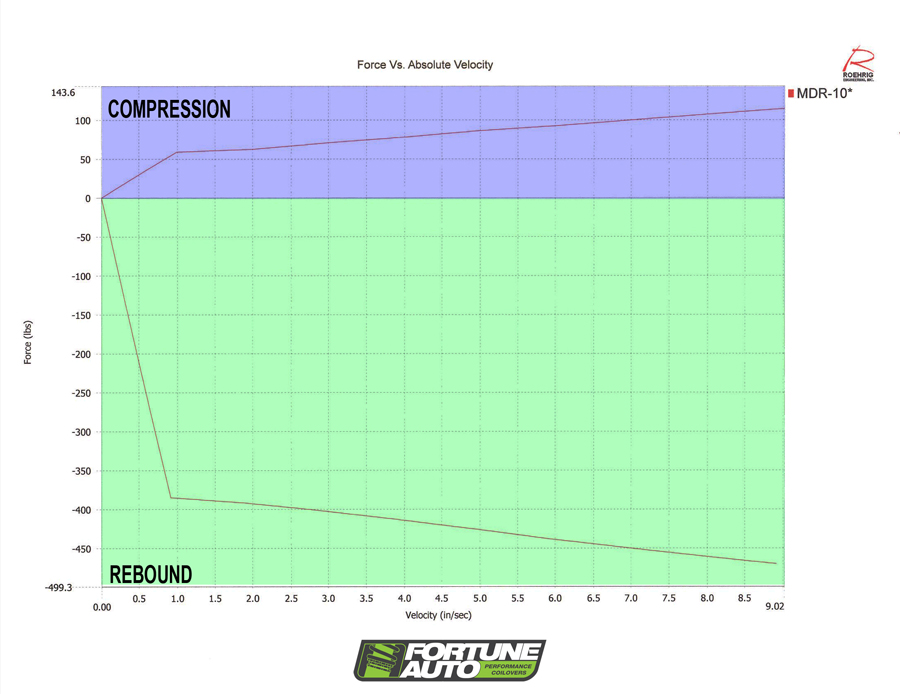
Velocity is shock shaft speed. Force is... force.
You've already noted that "low speed" is typically steering inputs (and to some extent, smaller bumps).
The graph is just showing you how much force it takes to move the shock at various shaft speeds. If you're moving it slowly, it takes less force. As you move it faster, it takes more force.
If the lines on the chart were straight lines. One straight line for compression, one straight line for rebound. That would be "linear" valving. I guess (maybe) you might find that in a race car. Or maybe before shocks got all fancy (whenever that happened) they could have been more simple devices with more linear response.
Now, street shocks (and as far as I know, most race shocks) have some degree of "digressive valving". What that means is that the shock responds in a linear fashion, gets stiffer as the shaft speed increases... but, does so at a pretty steep rate (this gives you crisp steering response). And then, as it reaches the "knee point", a secondary valve (or shim in the stack, or relief hole, or however they do it) opens up and lets to shock be "softer" for higher speed inputs.
That "knee point" is going to be somewhere just about the kind of shaft speeds you would typically see with steering inputs and "normal" bumps. The digressive valving is there to allow the suspension to suck up something like a speed bump, or a railroad crossing... or the curbing at turn 7 on Sebring. If the valving stayed linear, the car would "pogo" over a big bump like that.
How'd I do?
If you want to know more than that, you should talk to John Lambert. He's played with revalving Bilsteins and has a much better understanding of that kind of thing.
Loren Williams - Loren @ Invisiblesun.org
The "Push Harder, Suck Less" philosophy explained:
Push Harder - Drive as close to the limit of your tires as possible.
Suck Less - Drive something resembling a proper racing line.


 .
.